
The "ASO Plateau": What to Do When Your App Stops Growing
What is an ASO plateau, why organic growth levels off despite continuous optimization, and practical strategies to find your next growth leap when standard store optimizations stop working.
At first, ASO can feel almost predictable. You make a few changes, wait for the results, and something usually moves. You improve your keywords and your rankings start going up. You work on your screenshots and more people start installing. You localize your listing and suddenly you're getting downloads from markets you weren't even paying much attention to.
That early progress can make ASO feel like a game where every improvement gives you something back. Then, at some point, it slows down.
You're still checking keywords. You're still looking at competitors. You're still updating screenshots and making changes to your store listing. But when you look at the numbers, they barely move.
Your app hasn't necessarily become worse. You may have simply reached a point where the things that worked earlier aren't enough to create the next jump in growth. That's what people often experience as an ASO plateau.
The tricky part is figuring out what to do once you've reached it. There isn't always one obvious answer, and continuing to make the same changes can easily turn into busywork.
What is an ASO plateau?
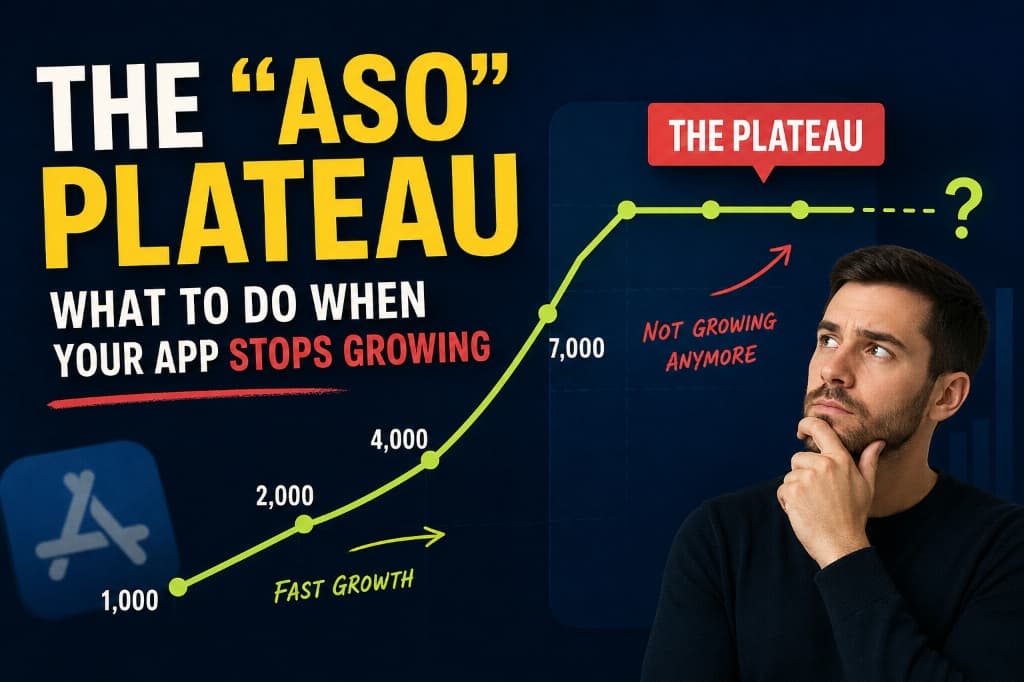
An ASO plateau is basically when an app's organic growth starts to level off even though you're still actively optimizing it. You might already rank well for your important keywords. Your listing might have a decent conversion rate, and your review count could be growing steadily.
For example, an app might go from:
1,000 → 2,000 → 4,000 → 7,000 monthly organic installs
and then move into something more like:
7,000 → 7,200 → 7,100 → 7,300
The app is still growing, but the pace has changed.
At this point, simply doing more of what worked earlier may not be enough. You have to figure out where the next opportunity actually is.
Your current keywords may have limited room left
Keywords are usually the first place we look when growth slows down, and for good reason. Search visibility is a major part of ASO.
But there is a point where you've already captured a large part of the opportunity from your main keywords. Moving from position 50 to position 10 can make a huge difference. Moving from position 20 to position 5 can also be significant. But if you're already sitting near the top, getting another small ranking improvement may not have the same impact.
This is where keyword research can become a little repetitive. You keep checking the same list because those are the keywords you've been tracking for months.
Instead, it can be useful to step outside that list. Look at longer-tail searches, problem-based searches, feature-specific searches, alternative use cases, new audience segments, and localized search terms. Think less about adding keywords and more about finding new ways people might be looking for the problem your app solves.
A keyword you have never tracked before could be more valuable than another small improvement to one you've been watching for months.
Your competitors may have caught up
Another thing worth checking is what has happened around your app.
Maybe your listing was noticeably better than the competition when you first optimized it. Your screenshots were clearer, your messaging was stronger, or you had a positioning advantage.
But competitors keep changing. They redesign their screenshots. They improve their ratings. They add features. They start targeting different keywords. They localize their listings.
None of that means your listing suddenly became bad. It just means the comparison has changed.
This is why I like occasionally going back to the search results and looking at them without thinking about your own app first. What are competitors showing in their first screenshot? What are they promising? Which apps are immediately understandable? Which ones make you curious enough to tap?
Then look at your own listing.
A simple question to ask is:
If I discovered this app today, would I choose it over the alternatives?
It's a much more useful exercise than only asking whether your own listing has improved since the last time you looked at it.
Your screenshots might be leaving installs on the table
Once someone finds your app, the next challenge is convincing them to install it.
This is where screenshots matter.
Most people aren't going to read an entire store listing carefully. They scan it, especially when they're comparing several apps at once. The first screenshot, in particular, has very little time to communicate what the product actually offers.
Take something like:
“The Best Way to Organize Your Life”
It sounds positive, but it doesn't tell the user much about the actual benefit.
Compare it with:
“Plan Your Week in Under 5 Minutes”
The second one gives you something concrete. You immediately understand the outcome.
So when reviewing screenshots, I wouldn't only ask whether they look good. I'd ask:
Would someone understand why this app is useful within a few seconds?
That question can lead to a much more useful redesign than simply changing fonts, colors, or layouts.
Design store-ready screenshots in minutes — free, no watermarks.
Launch Shots is free forever. Every template(110+), 220+ device frames plus 3D mockups, AI localization to 84 store languages, and direct upload to App Store Connect and Google Play Console. No credit card needed.
Start creating free →Don't look at traffic without looking at conversion
This is where the numbers become important.
Imagine your listing gets 100,000 impressions and 5% of those users install the app. That's 5,000 installs. Now imagine the impressions stay exactly the same, but conversion improves from 5% to 6%.
You now have 6,000 installs without getting any additional traffic.
That's a pretty significant difference.
So if impressions are healthy but installs aren't moving much, it makes sense to investigate the listing before immediately looking for more keywords. You could test the screenshot messaging, screenshot order, icon, subtitle, promotional messaging, app preview, or localization.
The important part is to test rather than change everything at once. If you redesign the entire listing and installs increase, you may never know which part made the difference. A smaller experiment gives you something much more useful: a clearer idea of what users respond to.
Maybe the next opportunity is somewhere else
Sometimes the issue isn't the listing at all.
Your current market may simply be getting harder to grow in. You've already captured a good portion of the demand that's easy to reach, while another market might still have plenty of room.
This is where localization becomes interesting.
But localization isn't just translating an English listing word for word. Search behavior can be different across languages and regions. People may use different terms for the same problem, and the way they respond to screenshots or messaging can differ too.
If you're entering a new market, it's worth treating it as a new ASO opportunity.
Look at local search terms, competitors, screenshots, reviews, messaging, and use cases. Try to understand how people in that market actually think about the problem.
Sometimes the next meaningful source of organic growth isn't another keyword in your current market. It is a market you haven't properly explored yet.
Turn guesses into experiments
Once you've been doing ASO for a while, it's easy to start making changes based on instinct.
“The screenshots probably need work.”
“We need more keywords.”
“The listing feels outdated.”
Those instincts can be useful, but they're only starting points.
Try turning them into questions you can actually test.
Instead of saying, “Our screenshots need improvement,” ask: “Would highlighting the main outcome in the first screenshot increase conversion?”
Instead of saying, “We need more keywords,” ask: “Are there searches around a specific use case that we're currently missing?”
And instead of saying, “The listing feels outdated,” ask: “Which part of the listing is actually underperforming?”
That small change makes ASO much more of a learning process.
Not every test will work, and that's okay. A failed experiment can still tell you something about what users don't respond to.
The important thing is that you're learning from each change instead of simply making another change because the previous one didn't work.
And sometimes ASO isn't the problem
There is also a point where the store listing stops being the main thing you need to worry about.
Suppose people are finding your app. They're installing it. Your conversion numbers look healthy.
But they aren't sticking around.
At that point, another screenshot redesign probably isn't going to solve the problem.
The user journey is much bigger than the store listing:
Impression → Store Visit → Install → First Session → Activation → Retention
If the first few stages are healthy but users disappear afterward, the issue could be onboarding, pricing, the product experience, missing functionality, or something else inside the product.
There can also be a mismatch between what the store listing promises and what users actually experience after installing.
That's an important distinction because it's easy to keep looking at ASO simply because that's the part you're used to measuring.
Sometimes the next growth problem isn't in the store. It's in the product.
So, what do you actually do next?
There isn't one trick that works for every app.
The first thing I'd do is figure out where the biggest opportunity is. If visibility is weak, go back to search behavior and audience research. If people are finding the app but not installing, focus on the listing and conversion. If installs are healthy but retention is poor, look at the product.
From there, I'd revisit the areas that are easiest to overlook: new search opportunities, competitors, screenshots, conversion, and other markets.
Most importantly, don't change everything at once.
Give each experiment a reason. Make the change. Watch what happens. Then use what you learn to decide what comes next.
That process is much more useful than endlessly tweaking the same keywords or redesigning the same screenshots without knowing what you're trying to solve.
The goal isn't to optimize forever
It's easy to think of ASO as a checklist: choose keywords, write metadata, create screenshots, get reviews, publish, and repeat.
But eventually, that approach starts to feel limiting.
The goal isn't to keep changing something every week just so you can say you're still doing ASO.
The goal is to understand where your growth is coming from, where it is slowing down, and what opportunity you haven't explored yet.
Your app doesn't need to rank for every keyword. It needs to reach the right people, communicate its value clearly, and give them a reason to install.
And when growth slows down, the answer isn't always to optimize harder.
Sometimes you need to stop looking at the same things and start looking somewhere new.
The plateau isn't the end of your ASO strategy.
It's usually the point where you need to find out what comes next.