
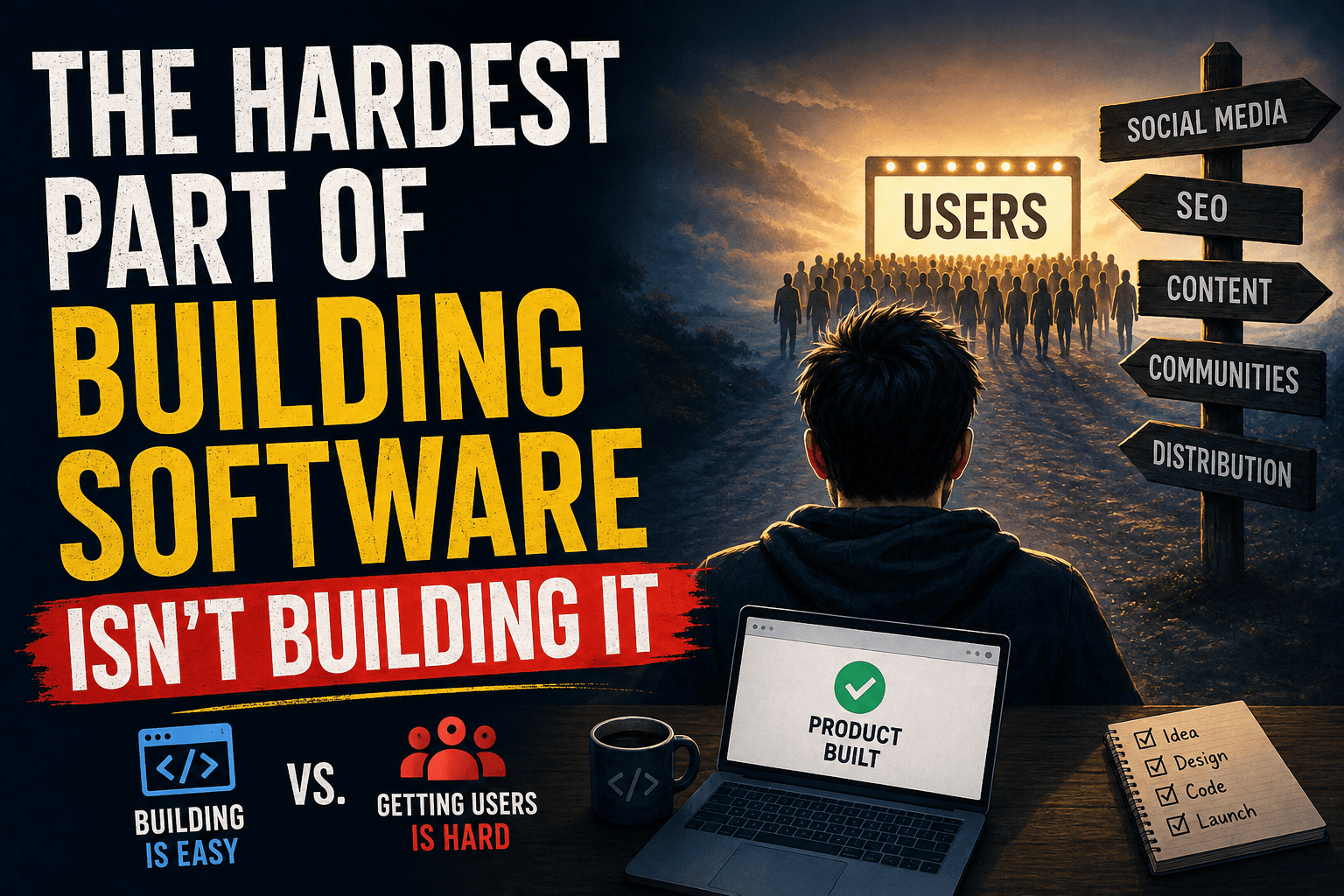
The Hardest Part of Building Software Isn't Building It
AI has made building products faster than ever. The real challenge now is getting people to discover them. Here is why distribution and visibility matter more than ever.
AI has made building products faster than ever. The real challenge now is getting people to discover them.
You spend weeks building a product.
You finally hit Deploy.
You post on Product Hunt. Share it on LinkedIn. Tweet about it. Maybe even tell your friends and a few communities you've been part of.
Then…
Almost nothing happens.
The product works.
The users just never arrive.
If that sounds familiar, you're not alone.
Building software has never been easier.
Getting people to notice it has never been harder.
AI Solved Building, Not Discovery
There has never been a better time to build software.
A few years ago, turning an idea into a working product required months of development, a full team, and a significant budget. Today, a solo developer with AI can design interfaces, generate code, fix bugs, write documentation, and deploy an application in a fraction of the time.
Need a landing page? AI can help.
Need a logo? AI can generate one.
Need marketing copy? AI can write a solid first draft.
Need code? AI can generate that too.
Building is faster.
Launching is easier.
Creating is cheaper.
But AI didn't solve one of the biggest challenges every founder eventually faces:
How do people discover your product?
Every day, thousands of new products are launched. Product Hunt is filled with fresh releases. LinkedIn feeds are packed with launch announcements. X is full of founders sharing what they've built.
The barrier to building has fallen.
The competition for attention has exploded.
Great Products Don't Automatically Find Users
One of the biggest misconceptions in tech is this:
"If the product is good enough, people will find it."
Unfortunately, that's rarely how it works.
History is filled with incredible products that never reached the audience they deserved—not because they lacked quality, but because they lacked visibility.
People can't use what they don't know exists.
A great product hidden in the corner of the internet is still invisible.
Distribution Builds Companies
For years, startups obsessed over building faster.
Today, many of them can.
The real question has changed.
Can you explain your product before someone scrolls away?
Every tweet.
Every LinkedIn post.
Every Product Hunt launch.
Every Reddit comment.
Every blog.
Every screenshot.
Every short demo video.
None of these are "just marketing."
They're your distribution engine.
Building creates products.
Distribution creates companies.
The startups that consistently show up where their audience already spends time are often the ones that keep growing.
You Have Seconds to Explain Your Product
Most people won't read your entire landing page.
They scan.
They glance at your headline.
They look at your screenshots.
They skim a few lines.
Then they decide whether you're worth another minute of their time.
That's why every visual matters.
Every headline matters.
Every screenshot matters.
Their job isn't to impress people.
Their job is to communicate value instantly.
Marketing Starts Long Before You Launch
Many founders think marketing begins after the product is finished.
In reality, it starts much earlier.
It starts when you begin sharing what you're building.
When you write about the problems you're solving.
When you answer questions in communities.
When you publish helpful tutorials.
When you share lessons learned instead of only announcing new features.
People rarely trust a product they've never heard of.
They trust people who've consistently helped them.
The goal isn't to shout louder.
It's to become someone worth listening to.
Visibility Beats Perfection
Think about the tools you use every day.
You probably didn't discover most of them through advertisements.
Maybe someone recommended them on Reddit.
Maybe you found a helpful blog while searching Google.
Maybe a founder shared their journey on LinkedIn.
Maybe you watched a short YouTube tutorial.
The best products don't simply exist.
They repeatedly appear where their audience is already looking.
Visibility compounds.
Silence doesn't.
Shipping Is an Event. Distribution Is a Habit.
Writing code has an end.
Marketing doesn't.
Even after launch, there's still work to do.
Write content.
Answer questions.
Collect feedback.
Improve your messaging.
Publish updates.
Keep showing up.
Distribution isn't a one-time campaign.
It's an ongoing habit.
The founders who keep educating, helping, and sharing are usually the ones people remember.
What Should Founders Focus On?
Keep building.
But spend just as much time thinking about how people will discover what you're building.
Write blogs that solve real problems.
Share insights instead of constant promotions.
Create visuals that explain your product in seconds.
Participate in communities where your audience already spends time.
Teach before you sell.
Help before you promote.
Because trust is earned long before someone clicks "Sign Up."
Final Thoughts
AI has dramatically lowered the barrier to building software.
That's an incredible opportunity.
But when everyone can build quickly, building alone is no longer enough.
The startups that stand out won't necessarily be the ones with the most features.
They'll be the ones that communicate clearly, educate consistently, and show up where their audience already is.
Anyone can ship software today.
Very few can consistently earn attention.
And in the AI era, attention has become one of the most valuable assets a startup can build.
Because the hardest part of building software...
isn't building it.
It's getting people to discover it.
Design store-ready screenshots in minutes — free, no watermarks.
Launch Shots is free forever. Every template(110+), 220+ device frames plus 3D mockups, AI localization to 84 store languages, and direct upload to App Store Connect and Google Play Console. No credit card needed.
Start creating free →