
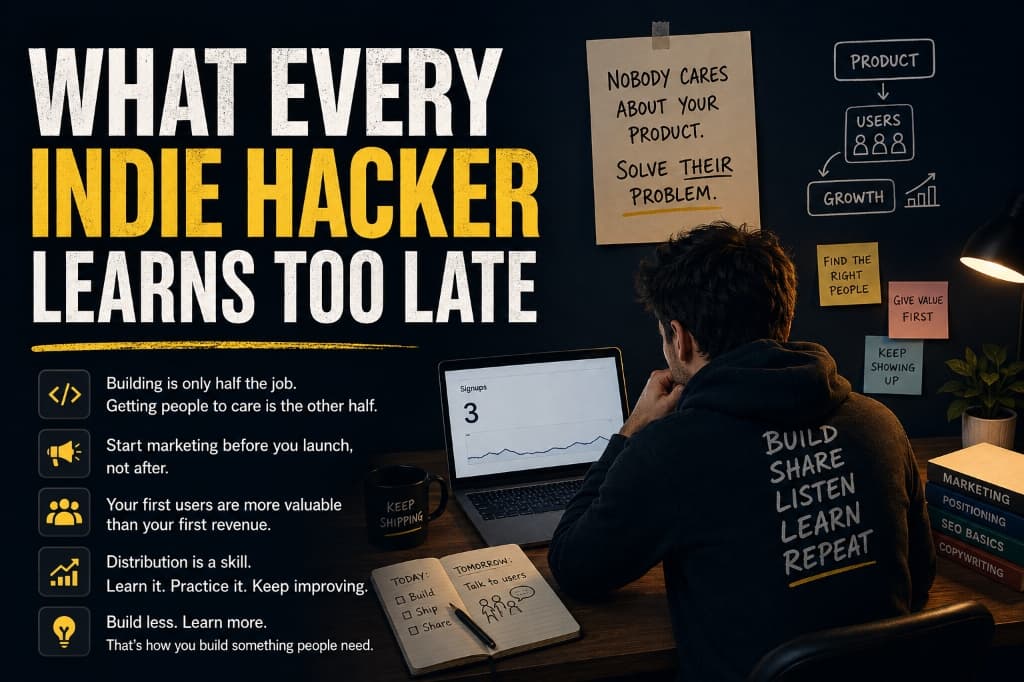
What Every Indie Hacker Learns Too Late
Building the product is only half the job. Discover the hard-earned lessons about marketing, distribution, and presentation that every indie hacker learns too late.
Building the product is only half the job. Getting people to notice it, understand it, and care about it is the other half.
You can spend six months building a product.
You can obsess over every feature.
Fix every tiny bug.
Rewrite the code because you know it could be cleaner.
Make the interface look perfect.
And then you launch...
And nobody comes.
That's one of the hardest lessons an indie hacker can learn.
Building the product is only half the job.
Getting people to notice it, understand it, and eventually care about it is the other half.
And honestly, that's where things get interesting.
Your Product Doesn't Market Itself
A lot of indie hackers start with the same assumption:
"If I build something genuinely useful, people will find it."
It sounds reasonable.
If the product solves a real problem, why wouldn't people use it?
Because the internet is already full of useful products that nobody knows about.
Your potential users aren't sitting around waiting for your next product to launch.
They're busy.
They're already using other tools.
They're scrolling through hundreds of posts every day.
They're getting recommendations from friends, seeing products on social media, reading blogs, and searching for solutions when they actually have a problem.
So even if you've built something genuinely useful, you still have to put it in front of the right people.
That's marketing.
And it doesn't start after launch.
Start Marketing Before You Launch
One of the easiest mistakes to make is waiting until the product is "ready" before talking about it.
By the time you launch, you might have a polished product...
but nobody waiting for it.
Instead, start sharing while you're building.
Talk about the problem you're trying to solve.
Share what you're learning.
Show early versions.
Ask people for feedback.
Talk about things that didn't work.
You don't have to turn every post into:
"Here's my product. Go use it."
Sometimes, simply sharing what you're building is enough.
You're giving people a reason to follow the journey.
And when launch day finally arrives, you're not introducing yourself for the first time.
Some people already know what you've been working on.
That matters.
Building in Public Is More Than Transparency
Building in public is often described as simply sharing your progress.
But there's another benefit that doesn't get talked about enough.
It creates distribution.
Every part of your product journey can become something worth sharing.
A new feature becomes a post.
A customer problem becomes a blog.
A failed experiment becomes a lesson.
A small milestone becomes a story.
A confusing bug becomes something another developer can learn from.
Suddenly, you don't have to sit there every morning wondering:
"What should I post today?"
Your product itself becomes the source of your content.
You're building the product and building awareness around it at the same time.
Your First Users Are More Valuable Than Your First Revenue
Your first users aren't just customers.
They're your research team.
They'll show you things you wouldn't have discovered by yourself.
They'll tell you:
- What's confusing
- What's missing
- What they actually care about
- Where they get stuck
- Why they chose your product
- Why they stopped using it
And that's why asking:
"Do you like the product?"
isn't always the best question.
Try asking:
- "What were you trying to accomplish?"
- "What almost stopped you from signing up?"
- "What did you expect to happen here?"
- "What were you using before this?"
The answers can be more valuable than a long list of feature requests.
Because sometimes users don't need another feature.
They need the existing product to make more sense.
Distribution Is a Skill
You don't need to become an influencer.
You don't need thousands of followers.
You don't need to post ten times a day.
But you do need to learn how to reach people.
That could mean:
- Writing useful SEO content
- Participating in Reddit communities
- Sharing what you're building on LinkedIn
- Posting on X
- Launching on Product Hunt
- Building partnerships
- Creating free resources
- Answering questions in your niche
There isn't one perfect marketing channel for every product.
The important thing is finding where your potential users already spend their time.
If your users are on Reddit, be there.
If they're searching Google for solutions, write content.
If they're discovering products through social media, show up there.
Distribution isn't something you magically get after building a product. It's something you learn.
Your Product Should Be Easy to Explain
Here's a simple test.
Imagine someone asks:
"What does your product do?"
If you need five minutes to explain it, you might have a marketing problem.
People don't usually give products five minutes to explain themselves.
They see a headline.
A screenshot.
A short video.
A social post.
And they make a quick decision about whether it's worth paying attention to.
That's why your messaging matters.
Your headline.
Your screenshots.
Your landing page.
Your social posts.
They should all communicate the same basic value.
Not everything has to be clever.
Not everything has to be complicated.
Sometimes the clearest explanation wins.
Clarity sells.
Don't Build Features Nobody Asked For
This is probably one of the easiest traps to fall into when you're building your own product.
You think:
"Maybe users need this."
So you build it.
Then you get another idea.
You build that too.
Then another.
A few weeks later, you've spent a huge amount of time building features that sounded useful in your head but weren't actually solving your users' biggest problems.
The solution isn't to stop building.
It's to start listening before building.
Talk to users.
Watch how they use the product.
Pay attention to what they repeatedly ask about.
Notice where they struggle.
Sometimes the best next feature isn't a new feature at all.
It might be fixing something that's already confusing.
Marketing Doesn't Mean Constant Promotion
There's a difference between marketing and promoting.
Promotion says:
"Here's our product. Buy it."
Marketing can say:
- "Here's how to solve this problem."
- "Here's something we learned."
- "Here's a useful resource."
- "Here's how other people are approaching this."
The second approach gives people something before asking them for something.
That's especially important when you're participating in communities like Reddit.
People can quickly tell when someone joined a community just to drop a link and leave.
Help first.
Be useful.
Become part of the conversation.
And when your product genuinely solves the problem being discussed, mention it.
That's much more natural than forcing your product into every conversation.
Don't Underestimate Presentation
You might have an excellent product.
But if your website looks unfinished, your screenshots are confusing, or people can't understand what they're looking at, they might never discover how good the product actually is.
Your visuals are part of your marketing.
A clean screenshot can explain a feature in seconds.
A well-designed product image can make someone stop scrolling.
A clear landing page can turn curiosity into a signup.
This doesn't mean everything has to be perfect.
It just needs to look intentional.
Because before someone experiences your product, they experience how you present it.
And that first impression matters.
Design store-ready screenshots in minutes — free, no export watermarks.
Launch Shots is free forever. Every template(110+), 220+ device frames plus 3D mockups, AI localization to 84 store languages, and direct upload to App Store Connect and Google Play Console. No credit card needed.
Start creating free →The Launch Isn't the Finish Line
Another lesson many indie hackers learn too late:
Launching isn't the end of marketing. It's the beginning.
You launch.
People arrive.
Some sign up.
Some leave.
Some give feedback.
And then the real work begins.
You still need to:
- Talk to users
- Publish content
- Improve SEO
- Share updates
- Experiment with different channels
- Collect feedback
- Improve onboarding
- Give people reasons to come back
A Product Hunt launch might give you a huge spike in traffic.
A viral post might bring thousands of visitors.
But traffic spikes aren't the same as sustainable growth.
What happens after that matters more.
Build Less. Learn More.
The goal isn't to build as many features as possible.
The goal is to learn what people actually want.
Sometimes that means launching a smaller product.
Sometimes it means talking to users instead of writing code.
Sometimes it means spending a week figuring out distribution instead of spending another week building a feature.
And that isn't time away from building.
That's part of building.
Because a product doesn't become valuable simply because you built it.
It becomes valuable when it reaches someone who needs it.
Final Thoughts
Being an indie hacker means wearing a lot of hats.
Developer. Designer. Marketer. Customer support. Product manager.
Sometimes all in the same day.
It's easy to spend most of your time doing the thing you're comfortable with.
For many indie hackers, that's building.
Writing code feels productive.
Shipping a feature feels productive.
Fixing a bug feels productive.
Marketing can feel uncomfortable.
Posting something that nobody reacts to can feel pointless.
Talking to users can feel slower than writing code.
But those uncomfortable parts can determine whether your product actually survives.
You can build faster.
You can add more features.
You can make the code cleaner.
You can spend months polishing the product.
But none of it matters if nobody knows it exists.
The biggest lesson isn't "market more."
It's simpler than that:
Don't wait until you've built something great to start telling people about it.
Build.
Share.
Listen.
Learn.
And keep showing up.