
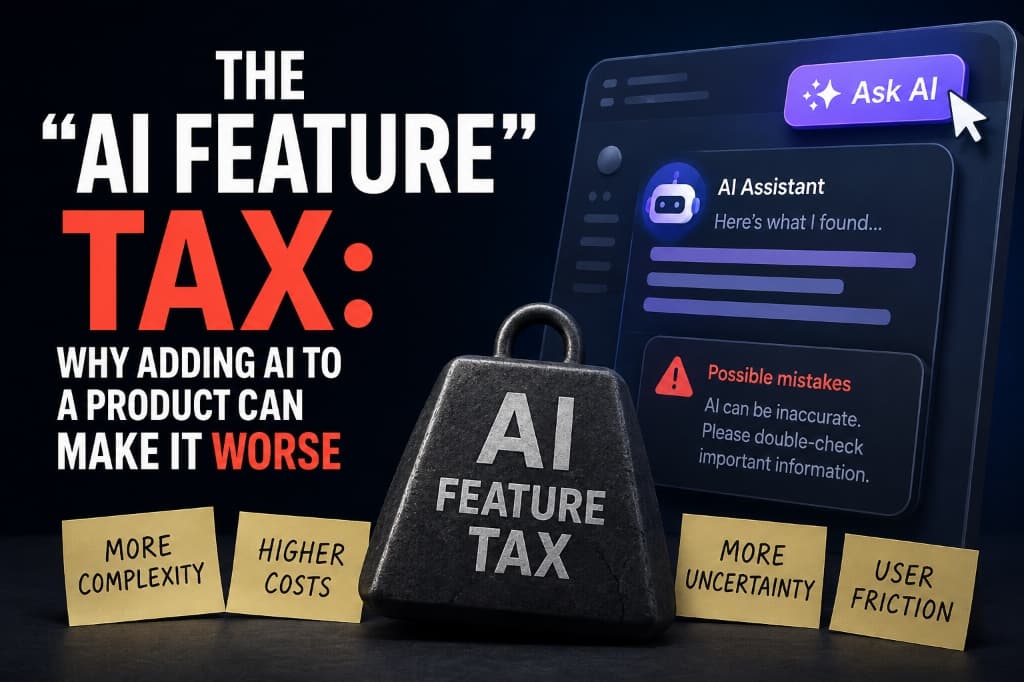
The "AI Feature" Tax: Why Adding AI to a Product Can Make It Worse
Not every product needs AI. Discover the AI feature tax—the added complexity, cost, uncertainty, and user friction when AI is added where simple software works better.
Not every product needs AI. In fact, sometimes adding AI can make a perfectly good product worse.
That's the part of the AI boom we don't talk about enough. A feature can be smarter, more advanced, and more impressive on a demo—and still create a worse experience for the person actually using it.
There was a time when adding a new feature to a product usually meant adding something useful. A better search experience, a faster checkout, a new way to organize information, or a feature that solved a problem users were already complaining about.
Then AI arrived.
Suddenly, almost every product had an opportunity to add an AI feature. Writing assistants appeared in email apps. AI summaries showed up in meeting tools. Chatbots were added to customer support software. Productivity apps started suggesting what users should do next.
And honestly, some of these features are genuinely useful.
But there's a growing problem with the way AI is being added to software. Sometimes, the question isn't “What problem can AI solve for our users?” It's “Where can we put AI in our product?”
That small difference can lead to a surprisingly bad product.
AI Isn't Automatically an Improvement
Adding AI to a product doesn't automatically make the product smarter. Imagine a note-taking app that already lets you search through your notes in a second. Now imagine adding an AI chatbot where you can ask the app what you wrote six months ago.
It sounds impressive.
But if the chatbot takes longer to respond, occasionally misunderstands your question, or gives you an answer without showing exactly where the information came from, the experience might actually be worse than simply searching your notes.
The AI feature is more advanced. The product isn't necessarily better.
This is the AI feature tax: the additional complexity, cost, uncertainty, and user friction that comes with adding AI where traditional software might already work well.
The Old Way Was Predictable
Traditional software is mostly deterministic. You click a button, something happens. You enter a password, the system checks it. You search for a word, the system finds matching results.
Users learn these patterns quickly because the software behaves consistently.
AI is different. Ask the same question twice and you might get two different answers. Give it slightly different information and it might interpret your request differently. Sometimes it gets things right. Sometimes it confidently gets them wrong.
That's not necessarily a flaw in AI. It's part of how probabilistic systems work.
But it creates a difficult design problem. Users still expect software to behave like software.
If an AI feature is going to make a recommendation, summarize something, generate content, or take an action on the user's behalf, the product needs to communicate what the AI is doing and what the user can expect from it.
Otherwise, the unpredictability becomes the user's problem.
More Intelligence Can Mean More Work
One of the promises of AI is that it reduces effort. But badly designed AI features can create a different kind of work.
Suppose an application automatically generates a summary of a meeting. Sounds great. You save time.
But now you have to read the summary carefully because you're not completely sure whether it missed something important. Maybe you need to compare it with the original transcript. Maybe you need to correct a few mistakes before sharing it with your team.
The task hasn't disappeared. Some of the work has simply moved from doing the task to checking whether the AI did the task correctly.
This is particularly important in situations where accuracy matters.
An AI-generated draft might save a writer time because the writer can edit it. But an AI-generated financial report, legal document, or technical configuration requires a very different level of trust.
The less tolerant the task is of mistakes, the more expensive AI's uncertainty becomes.
Design store-ready screenshots in minutes — free, no export watermarks.
Launch Shots is free to start. Every template (110+), 220+ device frames plus 3D mockups, AI localization, and direct upload to App Store Connect and Google Play Console. No credit card needed.
Start creating free →The “AI Everywhere” Problem
Another problem is that AI features can start appearing everywhere simply because users have become accustomed to seeing the AI label.
A button that says “Ask AI” gets added to the dashboard. Then another one appears inside the search page. Then there's an AI assistant in settings. Then an AI-generated recommendation appears on the homepage.
Eventually, the product starts feeling like it is constantly trying to have a conversation with you.
But not every interaction needs a conversation.
Sometimes users just want to click a button. Sometimes they want a filter. Sometimes they want a search box. Sometimes they want a setting that does exactly what it says.
The best AI experience might actually be the one where the user barely notices that AI is involved.
AI Should Remove Friction, Not Add a New Layer
The most useful AI features often have something in common: they fit naturally into an existing workflow.
Consider writing. If a user selects a paragraph and asks the product to make it shorter, AI can be genuinely helpful. The user already knows what they're doing, and AI simply makes that task faster.
But imagine forcing the user to open a separate AI chat, explain what document they're working on, copy the text into the conversation, ask for a rewrite, and then paste the result back.
The AI is doing the hard part. The product is making the user do more work to access it.
Good AI should feel like a shortcut. It shouldn't feel like another application you have to learn.
There's Also a Cost Nobody Sees
AI features aren't free just because they're easy to add from a user's perspective.
Behind the interface are model costs, infrastructure, latency, monitoring, rate limits, data handling, security considerations, and ongoing maintenance.
A traditional feature might have a relatively predictable cost per interaction. An AI feature can introduce variable costs depending on how much data is processed and how frequently users interact with it.
At small scale, this might not matter much.
At large scale, it can become a serious business consideration.
A feature that makes a product slightly more convenient isn't necessarily worth adding if every interaction significantly increases the cost of serving that user.
This is especially important for products with large numbers of free users.
The Bigger Problem Is Trust
The most valuable thing AI can add to a product isn't always intelligence.
It's confidence.
If an AI system helps me complete something faster while making it clear what it did, giving me control, and allowing me to correct it, I'm much more likely to trust it.
If it silently makes decisions for me and occasionally gets them wrong, I start treating every output with suspicion.
And once users have to verify everything an AI feature does, the promised time savings start disappearing.
This is why transparency matters.
Users should know when AI is being used, especially when the result can affect something important. They should have ways to review, edit, undo, or reject what the system produces.
The goal isn't to make AI look autonomous. The goal is to make the user feel in control.
Don't Add AI. Find the Right Job for It.
The best question for a product team isn't:
“Where can we add AI?”
It's:
“Where is the user spending unnecessary time, and could AI meaningfully reduce that effort?”
That's a much harder question.
It might lead to an AI feature. It might lead to a better search algorithm. It might lead to automation. It might lead to nothing at all.
And that's okay.
AI shouldn't have to appear in every part of a product to prove that the product is modern.
Sometimes the best product decision is to leave a perfectly good feature alone.
The Future Isn't AI Everywhere
We're probably going to see more AI inside software, not less.
But I don't think the winning products will necessarily be the ones with the most AI features. They'll be the ones that use AI where it genuinely improves the experience.
The difference is subtle but important.
AI shouldn't be another layer users have to navigate. It shouldn't turn simple actions into conversations. It shouldn't make users constantly wonder whether the system understood them correctly.
And it shouldn't exist just because every competitor has an AI button.
The best AI features will eventually become almost invisible. They'll remove repetitive work, handle complexity in the background, and give users better results without demanding attention for themselves.
That's probably the real test.
If removing the AI makes the product worse, it belongs there. If removing it changes nothing, maybe it was never needed in the first place.