
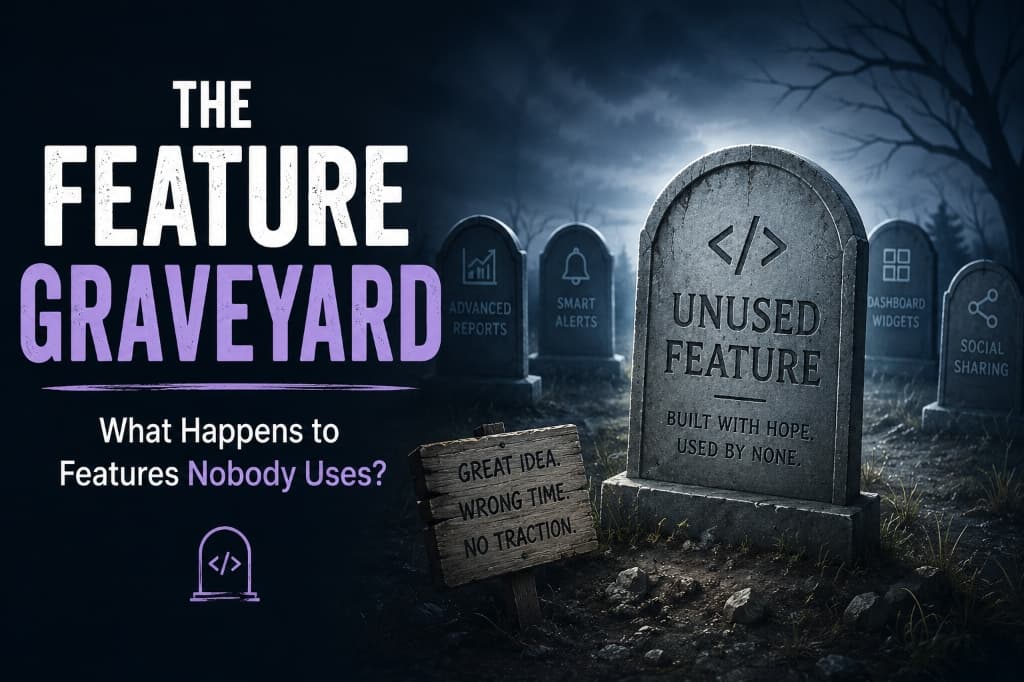
The Feature Graveyard: What Happens to Features Nobody Uses?
Every product has unused features that sit quietly taking up space. Discover why features end up in the graveyard, the hidden cost of keeping them, and how to know when to let go.
Every product has them.
Features that took days to build.
Features that looked exciting in planning meetings.
Features that everyone was convinced users would love.
And then…
Nobody used them.
They sit quietly inside the product, taking up space, adding complexity, and slowly becoming something the team stops thinking about.
Welcome to the feature graveyard.
Every Feature Starts With a Reason
Most unused features aren't bad ideas.
That's what makes this problem interesting.
A team usually doesn't build something for no reason.
Maybe users asked for it.
Maybe a competitor launched it.
Maybe the analytics showed an opportunity.
Maybe the founder thought it would make the product better.
Or maybe the team simply believed:
"Users are going to love this."
So they build it.
They test it.
They launch it.
And then the numbers arrive.
Almost nobody clicks it.
Building Is Easier Than Removing
Once a feature exists, removing it can feel like admitting failure.
The conversations usually sound something like:
- "But we spent three weeks building this."
- "What if users need it later?"
- "Maybe people just haven't discovered it yet."
- "Let's keep it for now."
And the feature stays.
Then another feature gets added.
And another.
And another.
Eventually, the product becomes complicated—not because anyone planned to make it complicated, but because nothing ever gets removed.
The Hidden Cost of an Unused Feature
An unused feature doesn't need to generate a bill every time someone ignores it.
It can still cost the team.
It might:
- Make the interface harder to navigate.
- Increase maintenance work.
- Add testing requirements.
- Create more documentation.
- Increase support questions.
- Make onboarding more confusing.
- Take attention away from more important features.
The feature might have almost zero users and still create work.
That's one of the strange things about software.
Unused code can still have a cost.
More Features Don't Always Mean More Value
It's easy to measure progress by the number of features shipped.
Five features this month.
Ten next month.
Twenty by the end of the year.
It feels productive.
But users don't choose a product because it has the longest feature list.
They choose it because it helps them do something better, faster, or easier.
Sometimes another feature improves that experience.
Sometimes it just gives users one more thing to figure out.
More isn't automatically better.
Sometimes it's just more.
But What If Users Can't Find the Feature?
Here's where things get interesting.
A feature with low usage isn't necessarily a useless feature.
Maybe users simply don't know it exists.
That's an important difference.
Before removing something, ask:
"Are users ignoring this feature, or are they unable to find it?"
A useful feature buried inside a confusing menu can look completely useless in your analytics.
Better onboarding might help.
Clearer navigation might help.
A better label might help.
A small in-product prompt might help.
So before sending a feature to the graveyard, make sure it actually deserves to go there.
Talk to the Users Who Actually Use It
Analytics can tell you what is happening.
Users can often tell you why.
If only 2% of users use a feature, talk to some of those users.
Ask them:
- "Why do you use it?"
- "What problem does it solve for you?"
- "What would you do if this feature disappeared tomorrow?"
You might discover that the feature isn't popular, but it's extremely valuable to a small group of users.
And that's an important distinction.
A feature doesn't have to be popular to be valuable.
The Question Every Feature Eventually Faces
At some point, every product team should ask:
"If we didn't have this feature today, would we build it again?"
If the answer is no, that's worth investigating.
Maybe the feature needs a redesign.
Maybe it should be hidden from most users.
Maybe it should be combined with something else.
Or maybe… it should be removed.
The amount of time already spent building something shouldn't decide whether it deserves to stay.
That's just the sunk cost trap.
Removing a Feature Is Also Product Development
Deleting something can feel like going backwards.
It isn't.
Removing unnecessary complexity can be progress too.
When a feature disappears, the product can become:
- Easier to understand.
- Easier to maintain.
- Easier to onboard.
- Easier to explain.
- Easier to navigate.
Sometimes the best product update isn't:
"We added something new."
It's:
"We made the product simpler."
And users might appreciate that more than another button in the interface.
But Don't Turn It Into a Cleanup Exercise
There's another trap here.
A team can become obsessed with removing anything that doesn't have huge usage numbers.
That's not always smart.
Some features are rarely used but become extremely important when someone needs them.
Take an export button.
Most users might never touch it.
But the users who do might depend on it.
So usage alone shouldn't decide a feature's fate.
Look at the bigger picture:
Usage + value + user feedback + maintenance cost.
That's a much better way to evaluate whether something deserves to stay.
Build With a Question, Not Just a Feature
Before building something, ask:
What problem are we solving?
Then:
Who actually has this problem?
And finally:
How will we know we've solved it?
These questions sound simple.
But they can save weeks of development.
Instead of celebrating how many features the team shipped, celebrate how many real problems were solved.
That's a much better measure of progress.
The Graveyard Isn't Always a Bad Thing
Every product will eventually have features that didn't work out.
That's normal.
Some ideas will fail.
Some experiments won't get traction.
Some features will become obsolete.
That's part of building software.
The goal isn't to avoid the feature graveyard completely.
The goal is to learn from what ends up there.
If five features fail for the same reason, that's useful information.
If users consistently ignore a certain type of functionality, that's a signal.
If removing something actually improves engagement, that's a lesson.
Failure becomes valuable when you pay attention to it.
Design store-ready screenshots in minutes — free, no export watermarks.
Launch Shots is free forever. Every template(110+), 220+ device frames plus 3D mockups, AI localization to 84 store languages, and direct upload to App Store Connect and Google Play Console. No credit card needed.
Start creating free →Final Thoughts
Good products aren't built by endlessly adding.
They're built by understanding what deserves to stay.
Every feature should earn its place—not because the team spent weeks building it, but because it genuinely helps someone.
Sometimes that means building something new.
Sometimes it means improving something that already exists.
And sometimes…
it means opening the feature graveyard and finally letting something go.
Because in software, less isn't always more.
But unnecessary is never free.