
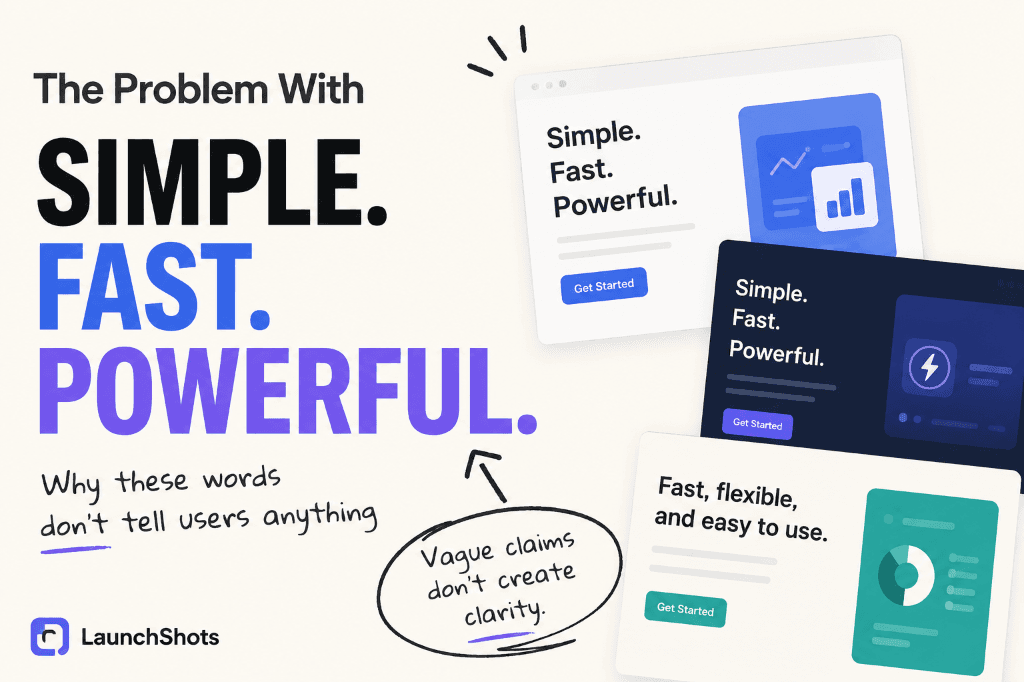
The Problem With “Simple, Fast, Powerful”
Vague marketing buzzwords like simple, fast, and powerful don't tell users anything. Discover why specificity, evidence, and clear copy win over generic adjectives.
Simple. Fast. Powerful.
You've probably seen these words on hundreds of SaaS websites.
Maybe you've even stopped noticing them.
Open almost any landing page and you'll find some version of:
- Simple project management.
- Fast workflows.
- Powerful analytics.
- Effortless collaboration.
- Intelligent automation.
They sound good.
They also sound like almost everyone else.
And that's the problem.
When Every Product Sounds the Same
Imagine you're looking for a new productivity tool.
You visit the first website.
"Simple. Fast. Powerful."
You check another.
"Fast, flexible, and easy to use."
Then another.
"Powerful tools for modern teams."
Three different products.
Three different companies.
But somehow, they all sound the same.
So what are you supposed to remember?
The problem isn't that these words are wrong.
The problem is that they don't tell you much.
Simple Compared to What?
"Simple" is probably one of the most overused words in software marketing.
But simple compared to what?
A product can have fifty features and still feel simple.
Another can have five features and feel confusing.
So when a company says:
The next question should be:
What makes it simple?
- Can I start using it without reading documentation?
- Can I finish the setup in two minutes?
- Does it remove unnecessary configuration?
- Can a first-time user understand what to do immediately?
That's useful information.
"Simple" isn't the information.
It's the conclusion.
Show me why it's simple.
Fast Doesn't Mean Much Either
Then there's "fast."
- Fast setup.
- Fast workflows.
- Fast results.
- Lightning-fast performance.
Okay.
How fast?
If your competitor takes ten minutes and your product takes thirty seconds, that's interesting.
But saying:
doesn't give me anything to compare.
For example:
sounds impressive.
But:
tells me something.
One sounds like marketing.
The other gives me a reason to believe the claim.
And Then We Have "Powerful"
Almost every SaaS product is powerful.
- Powerful AI.
- Powerful analytics.
- Powerful automation.
- Powerful integrations.
- Powerful customization.
But what does "powerful" actually mean?
A user doesn't wake up thinking:
"I need a powerful piece of software today."
They think:
"I need to automate this boring task."
"I need to understand why users are leaving."
"I need to create screenshots for my App Store listing."
"I need to finish this in less time."
Power isn't the benefit. What power enables is the benefit.
That's what your marketing should explain.
Design store-ready screenshots in minutes — free, no export watermarks.
Launch Shots is free forever. Every template(110+), 220+ device frames plus 3D mockups, AI localization to 84 store languages, and direct upload to App Store Connect and Google Play Console. No credit card needed.
Start creating free →The Internet Has a Marketing Vocabulary
There's another problem.
Companies have learned what "good marketing" is supposed to sound like.
So they use the same vocabulary.
Simple. Fast. Modern. Powerful. Seamless. Effortless. Intelligent. Innovative.
Eventually, these words stop helping you stand out.
It's like meeting ten people who introduce themselves by saying:
"I'm hardworking, passionate, innovative, and results-driven."
Sounds nice.
But what did you actually learn about them?
Not much.
You learned how they want to be perceived.
The same thing happens with product marketing.
Show Me Instead
There's a simple way to fix this.
Show, don't just tell.
- Instead of saying your product is easy to use, show the workflow.
- Instead of saying it's powerful, show what it can do.
- Instead of saying it's fast, show the result.
- Instead of saying it's better, show the difference.
A screenshot can communicate something a paragraph can't.
A short demo can prove a workflow.
A before-and-after image can make an improvement obvious.
A real example can turn a vague claim into something concrete.
You don't have to say:
You can simply show someone completing the task in three steps.
Proof is stronger than adjectives.
Specificity Makes Marketing Better
Compare these two:
and:
The second one isn't necessarily more exciting.
But it's much clearer.
I know what I'm starting with.
I know what I'm getting.
I understand the problem it removes.
That's what good marketing should do.
It shouldn't just sound good.
It should make sense.
Talk Like Your Customers Talk
Product teams sometimes forget that customers don't use the same language they do.
Inside a company, someone might say:
A customer might say:
They're talking about roughly the same thing.
But one sounds like a presentation.
The other sounds like a person.
Your customers might say:
"I don't want to spend three hours making screenshots."
That's valuable.
Because now you know what the real problem sounds like.
Listen to the words customers use.
- Their frustrations.
- Their questions.
- Their desired outcomes.
Then use those words in your marketing.
Good copy often starts with listening.
Don't Try So Hard to Sound Impressive
There's a temptation to make every headline sound important.
Add another adjective.
Then another.
Make the claim bigger.
Make the sentence more dramatic.
But sometimes the strongest headline is surprisingly boring.
That's not revolutionary copy.
But I immediately understand it.
And understanding is more valuable than sounding impressive.
Clarity Is a Competitive Advantage
When everyone uses the same marketing language, specificity becomes a competitive advantage.
Your competitor says:
You say:
Now I know what you do.
I know what problem you're solving.
I can decide whether I need it.
You didn't need a cleverer sentence.
You just needed a clearer one.
Replace Adjectives With Evidence
The next time you write:
Ask: How?
When you write:
Ask: How fast?
When you write:
Ask: What can I actually do with it?
When you write:
Ask: What makes it easier than the alternative?
When you write:
Ask: How much does it cost, and what do I get?
Every vague adjective is an opportunity to become more specific.
And specificity gives people something they can actually understand.
Let Customers Reach the Conclusion
The strongest marketing doesn't tell people:
"You should think our product is amazing."
It gives them enough information to reach that conclusion themselves.
- Show the workflow.
- Show the result.
- Show the difference.
- Show the time saved.
- Show the actual product.
Let the evidence do some of the selling.
Because when someone looks at your product and thinks:
"Okay, I can see how this would help me."
You've done something much more valuable than making your copy sound impressive.
You've made them understand.
Final Thoughts
"Simple."
"Fast."
"Powerful."
There's nothing wrong with these words.
The problem is that they've become shortcuts for explaining something we haven't actually explained.
Your customers don't need more adjectives.
They need answers.
What does it do?
Who is it for?
What problem does it solve?
How is it different?
What will I actually get?
The best marketing isn't necessarily the marketing with the cleverest words.
It's the marketing that leaves the least confusion behind.
So the next time you're about to write:
Simple. Fast. Powerful.
Stop for a second.
Ask yourself: Can I say something more useful instead?