
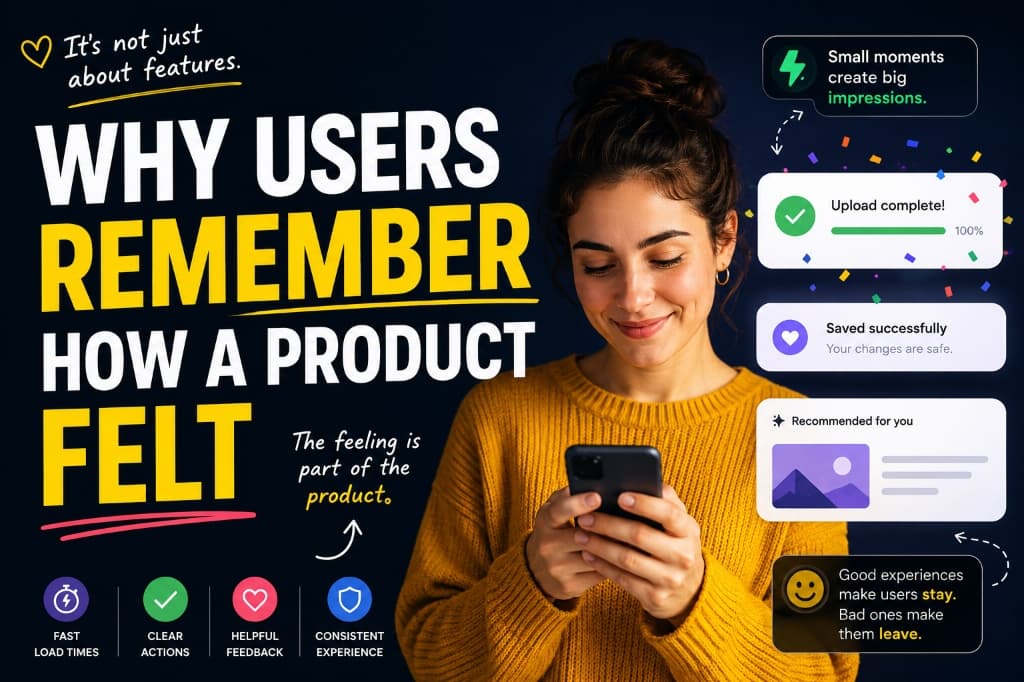
Why Users Remember How a Product Felt
Features fade, but feelings stick. Discover why product experience is built through micro-moments, consistency, and friction-free interactions—and why how a product feels determines whether users return.
You can forget a password. You can forget a feature. You can even forget the name of an app. But sometimes, you remember exactly how using it felt.
You can forget a password.
You can forget a feature.
You can even forget the name of an app.
But sometimes, you remember exactly how using it felt.
That feeling is part of the product.
Think about the last app that made you think:
"This is so easy to use."
You probably don't remember every button on the screen.
You remember that nothing felt difficult.
Now think about a product that constantly confused you.
Maybe you couldn't find what you needed.
Maybe the interface felt overwhelming.
Maybe every small task took longer than it should.
You might not remember exactly what went wrong.
But you remember that using it was frustrating.
And that's what makes product experience so interesting.
Users Don't Experience Features. They Experience the Product.
Product teams think in features.
Users usually don't.
You might think:
The user thinks:
You might think:
The user thinks:
That's the difference.
Users don't experience your roadmap.
They experience the result of your decisions.
Every interaction adds something to their overall impression of the product.
Small Moments Add Up
Product experience isn't created by one huge feature.
It's built through hundreds of tiny moments.
- How quickly a page loads
- How clear a button is
- What happens after you click it
- Whether an error message actually helps
- How easy it is to undo something
- Whether the product remembers your preferences
- Whether things behave the way you expect
Most of these moments are too small to notice individually.
But they add up.
A fast-loading page.
A clear confirmation message.
A button that does exactly what you expected.
A form that doesn't make you enter the same information twice.
None of these sounds revolutionary.
But together, they create a product that feels good to use.
Good experiences accumulate. Bad experiences accumulate too.
The "This Just Works" Feeling
Some products have a quality that's difficult to explain.
You open them and immediately know what to do.
You don't need a tutorial.
You don't need to search through settings.
You don't need to ask someone for help.
You just start.
That's rarely an accident.
It usually comes from removing unnecessary decisions, creating clear flows, choosing sensible defaults, and understanding how people actually use the product.
The best compliment a product can receive might not be:
"It has amazing features."
It might be:
"It just works."
Users Remember Friction Too
Unfortunately, the opposite is also true.
Imagine signing up for a service.
- You create an account.
- Then you're asked to verify your email.
- Then complete a profile.
- Then choose your preferences.
- Then watch an onboarding video.
- Then configure your settings.
You haven't even used the product yet.
Every step might have a logical reason.
But the overall experience feels exhausting.
Users don't think:
"This company has a well-designed five-step onboarding architecture."
They think:
"This is too much work."
That's the feeling they'll remember.
And sometimes, that's enough to make them leave.
Design store-ready screenshots in minutes — free, no export watermarks.
Launch Shots is free forever. Every template(110+), 220+ device frames plus 3D mockups, AI localization to 84 store languages, and direct upload to App Store Connect and Google Play Console. No credit card needed.
Start creating free →The Emotional Side of Software
We often talk about software as if it's purely functional.
Does it work?
Is it fast?
Does it have the right features?
But people aren't machines.
They can feel:
- Confident
- Confused
- Excited
- Frustrated
- Curious
- Relieved
- Overwhelmed
A product can technically work perfectly and still create the wrong experience.
A complicated workflow can make users feel frustrated.
A clear interface can make them feel confident.
A useful confirmation can make them feel relieved.
A fast product can make it feel effortless.
These reactions might not appear directly in your analytics.
But they influence what happens next.
- Do users return?
- Do they recommend the product?
- Do they keep using it?
- Or do they quietly look for an alternative?
Trust Is Built Through Consistency
Imagine a product that behaves differently every time you use it.
A button moves.
A familiar action suddenly works differently.
An option disappears.
A notification appears without explanation.
Even small inconsistencies can make users feel uncertain.
Consistency creates the opposite feeling.
When things behave the way users expect, they don't have to constantly question the interface.
They can focus on what they came to do.
That builds trust.
And once users trust a product, using it becomes easier.
Delight Doesn't Mean Adding Confetti
When people talk about creating memorable experiences, they often think about surprises.
Animations.
Confetti.
Funny messages.
Hidden easter eggs.
Those things can be fun.
But delight doesn't always have to be loud.
Sometimes delight is:
- A form that remembers your information.
- A file that uploads faster than expected.
- An error message that actually tells you what to do.
- A setting that works exactly as you expected.
- A product that lets you try it before forcing you to create an account.
The best moments can be almost invisible.
You notice them because something didn't get in your way.
What Happens After the Click Matters
A button isn't just a button.
It's a promise.
When someone clicks "Save," they expect something to be saved.
When they click "Download," they expect a file.
When they click "Create," they expect something to appear.
If the result matches the expectation, trust increases.
If nothing happens, something unexpected happens, or the interface gives no feedback, uncertainty appears.
Good products constantly answer a silent question:
"Did what I just did actually work?"
That tiny moment after an action can matter more than we think.
You Can't Design the Feeling Directly
You can't simply tell your team:
"Let's make the product feel trustworthy."
It doesn't work that way.
You have to design the things that create trust.
- Clear communication
- Consistent behavior
- Fast feedback
- Thoughtful defaults
- Reliable performance
- Simple workflows
- Good error handling
The feeling comes from all of these decisions working together.
You don't design the feeling directly.
You design the experience that creates it.
Ask Different Questions
Instead of asking:
"How many features did we ship?"
Ask:
"What did the user experience?"
Instead of:
"Did they complete the flow?"
Ask:
"Where did they hesitate?"
Instead of:
"Do users understand this feature?"
Ask:
"What did they expect to happen?"
These questions can reveal things that analytics alone can't.
A user might complete a checkout flow.
But that doesn't mean the experience was good.
They might have completed it after getting confused three times.
They might have searched for the right button.
They might have almost given up.
The numbers tell you what happened.
Looking at the experience helps you understand why it happened.
The Product People Remember
People may forget your exact interface.
They may forget where a particular button was.
They may forget half the features you spent months building.
But they'll remember whether your product felt easy or difficult.
Whether it respected their time.
Whether it made them feel confident.
Whether it helped them accomplish something without getting in the way.
That's why product experience matters.
Because users don't walk away carrying your feature list in their heads.
They walk away carrying an impression. And that impression can determine whether they come back.
Final Thoughts
A great product isn't just something that works.
It's something that feels right to use.
Every interaction contributes to that feeling.
Every delay.
Every confusing label.
Every smooth transition.
Every helpful message.
Every unnecessary step.
Users might not remember each one individually.
But together, they become the experience.
And long after users forget the features, the interface, and even the details of what they did inside your product...
they may still remember how it made them feel.