
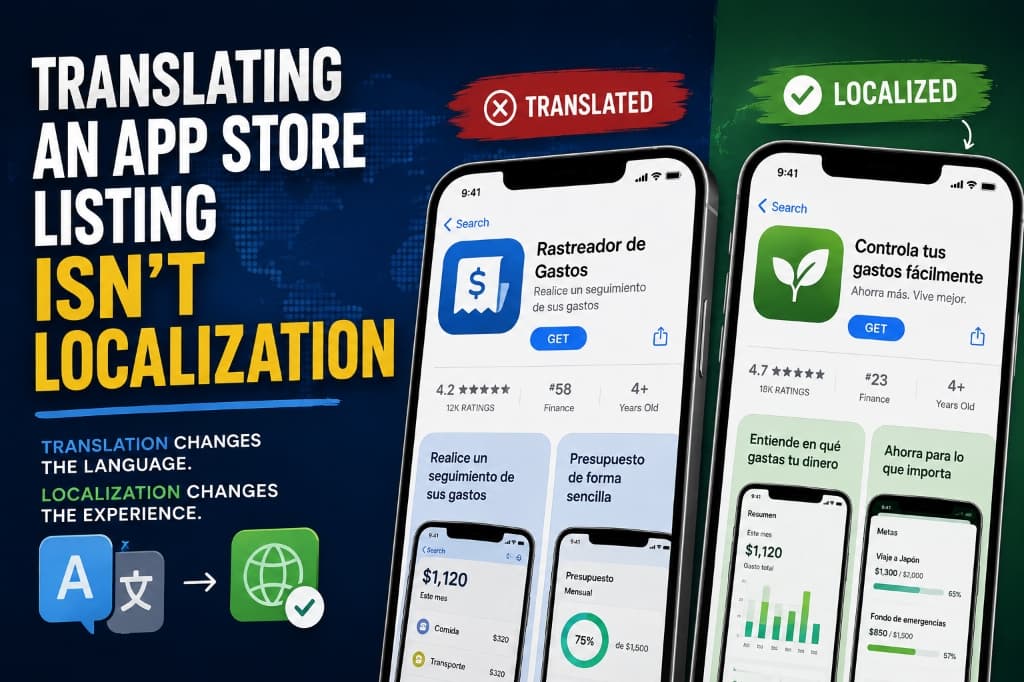
Translating an App Store Listing Isn’t Localization
Why simply translating your app store title, screenshots, and keywords into Spanish or other languages isn't true localization—and how adapting context, search behavior, and visual presentation drives real international ASO growth.
You translate your app listing into Spanish. The title is translated, the subtitle is translated, the description is translated, and even the text inside your screenshots has been changed into Spanish. Everything looks ready, so you publish the listing in a new market and wait for the downloads to come in.
Nothing happens.
Maybe you try another language. You translate the listing again, publish it, and wait. Still, the results aren't what you expected.
At this point, it is easy to assume that localization doesn't work or that the market simply isn't interested in your app. But the problem may have nothing to do with the market itself. You may have translated your listing without actually localizing it.
There is an important difference between the two. Translation changes the language. Localization changes the experience. In ASO, that difference matters because people in different markets don't necessarily search for, describe, or respond to a product in the same way.
Translation changes words. Localization changes context.
Imagine that your app helps people split expenses with their friends, and one of your English screenshots says, “Split the bill with your friends.”
A translator can translate that sentence perfectly. The grammar can be correct, the meaning can be preserved, and the translated version can look completely fine on the surface. But that doesn't necessarily mean it is the way people in that market would naturally describe the action.
Maybe people use a different expression when talking about splitting expenses. Maybe there is another term that is more commonly associated with this type of app. Perhaps the problem your screenshot is highlighting isn't the main reason people in that market download these apps in the first place.
This is where simple translation starts to fall short.
A translated listing can be grammatically perfect and still feel like it was written for someone somewhere else. Localization requires you to understand the context behind the language: how people search, what terminology they use, what problems they care about, and how they expect products like yours to communicate with them.
People don't search using translations
This becomes particularly important when you start looking at ASO keywords.
Suppose your English keyword is “expense tracker.” It might seem logical to translate those two words and use the translated phrase as your primary keyword in another market. But people don't necessarily search for a concept by directly translating the English phrase in their heads.
They search for what they would naturally type when they need that particular solution.
There may be several ways to describe the same product or feature in a language, but only some of them might be commonly used in app searches. A phrase that sounds perfectly correct to a translator could be something that real users rarely type.
That's why localized keyword research needs to go beyond translation. Instead of asking, “What's the translation of this keyword?”, a better question is, “What would someone in this market actually type if they were looking for an app like mine?”
Those two questions can lead to very different answers.
You also need to consider how competitors in that market describe their products. The language appearing repeatedly across app titles, subtitles, descriptions, and reviews can give you clues about the terminology users are already familiar with.
The same feature can need a different message
Localization can also change the way you communicate your product's value.
Consider a fitness app whose English screenshot says, “Get Fit in 20 Minutes a Day.” The message is clear, and there is nothing inherently wrong with it. But when you enter another market, you might discover that workout duration isn't the strongest reason people are interested in this type of app.
Perhaps home workouts are a bigger selling point. Maybe users care more about meal planning, beginner-friendly exercises, or a particular type of training. It could also be that the terminology commonly used for a specific exercise or fitness goal is different from the language used in your original listing.
The product itself hasn't changed. The features are still there, and the app still solves the same underlying problem. What changes is the way you communicate its value to a particular audience.
That's an important part of localization. You're not inventing a completely different product for every country. You're figuring out which parts of the existing product are most meaningful to the people you're trying to reach.
Your screenshots need localization too
Screenshots are another area where teams often stop too early. They translate the text inside the images, replace the English copy, export the new screenshots, and consider the localization finished.
But screenshots aren't just text. They're visual communication, and changing the language can affect the entire design.
A short English headline might become considerably longer after translation. That can change the number of lines, font size, spacing, alignment, and even the amount of the actual app interface that remains visible. If the translated text doesn't fit naturally, the screenshot can start looking crowded or poorly designed.
There is also a bigger question to consider: should your screenshots communicate exactly the same things in every market?
Not necessarily.
Your first screenshot is valuable real estate. It is often one of the first things a potential user sees, so the benefit you choose to highlight there matters. If users in one market care strongly about one feature while users in another market respond more to something else, your screenshot strategy should at least take that into account.
Localization gives you the opportunity to rethink the message instead of simply replacing one language with another.
Design store-ready screenshots in minutes — free, no export watermarks.
Launch Shots is free forever. Every template(110+), 220+ device frames plus 3D mockups, AI localization to 84 store languages, and direct upload to App Store Connect and Google Play Console. No credit card needed.
Start creating free →Localization can affect the entire visual presentation
There are also smaller details that can have a surprisingly large effect on how natural your listing feels.
Different languages can require very different amounts of space. Some languages naturally produce longer phrases, while others may require different typography or layout considerations. Languages such as Arabic and Hebrew also introduce right-to-left design requirements, which can affect the positioning and direction of interface elements.
Then there are things like dates, currencies, numbers, and measurements.
For example, an app that displays a price as “$9.99” may need to present that information differently depending on the market. Similarly, a date such as “12/05/2026” can be interpreted differently depending on the country's conventions.
These details may seem minor when considered individually, but they contribute to the overall impression of the product. When everything from the language to the formatting feels familiar, the listing feels more naturally connected to the market.
Your competitors are local too
There is another reason localization requires research: your competitive landscape can change from one market to another.
The app that dominates your category in the United States may not be the app users are comparing you with in another country. A local competitor may have stronger visibility, thousands of reviews, familiar terminology, and screenshots that have already been designed around the expectations of that audience.
If you enter the market with a listing that has simply been translated from English, you're not just competing against their product. You're also competing against how well they understand and communicate with the local audience.
This is why competitor research should be part of your localization process.
Before entering a new market, look at the apps already performing well there. Pay attention to the keywords they use, how they describe their products, which benefits they emphasize in their screenshots, and how users talk about them in reviews.
You don't need to copy what your competitors are doing. The point is to understand the market you're entering and the language that already exists within it.
Reviews are a localization goldmine
One of the most useful sources of this information is something you already have access to: user reviews.
Marketing copy is usually carefully written. Reviews are not. Users describe products in their own words, which makes them particularly useful for understanding how people actually talk about a problem or feature.
A review might reveal what users call a particular feature, what problem they were trying to solve, or which part of the product convinced them to download it. It can also reveal recurring complaints and frustrations that your own marketing team may not have considered.
This becomes especially valuable when you're researching a new market. Looking at reviews of similar apps can help you understand the vocabulary users naturally use instead of relying entirely on translated marketing language.
If the same phrase keeps appearing in reviews, that's worth paying attention to. It might give you an idea for a keyword, a screenshot headline, or even a different way to explain one of your product's benefits.
Localization doesn't mean changing everything
There is also a common misconception that localization means creating a completely different app store listing for every country.
It doesn't have to.
Your core product and value proposition should remain consistent. If your product is a habit tracker, it is still a habit tracker whether the user is in India, Germany, Japan, or Brazil. You don't need to create a completely different identity for every market.
The goal is to make the same product feel relevant to the people you're presenting it to.
A useful way to think about the difference is this:
Translation asks: “How do we say this in their language?”
Localization asks: “How would we naturally communicate this to them?”
That second question changes the way you approach ASO. Instead of starting with your existing English listing and trying to convert every word, you start thinking about the person who is going to see the listing.
A practical localization process
So what does this actually look like when you're preparing to enter a new market?
Start with research rather than translation. Look at the apps that are already performing well in the market, study their positioning, read their reviews, and pay attention to the terminology they use. This gives you a much better understanding of how the category is presented locally.
Next, research your keywords specifically for that market. Don't simply take your existing English keyword list and translate every term. Find out what people actually search for and which phrases are commonly associated with your category and product.
Once you understand the search behavior, look at your messaging. Think about which problems and benefits are most relevant to that audience and whether the way you're describing them sounds natural. Sometimes the best localized version of a sentence isn't a literal translation at all.
Then review your screenshots. Translate the copy, but don't stop there. Check whether the text still fits naturally, whether the hierarchy works, whether the UI remains visible, and whether the benefits you're highlighting make sense for that market.
You should also check the technical details that are easy to overlook, including currencies, dates, measurements, number formats, and right-to-left layouts where necessary.
If possible, get feedback from someone who actually knows the language and market. A sentence can be grammatically correct and still sound unnatural to a native speaker. That kind of feedback can catch problems that automated translation tools won't.
Finally, measure what happens after the listing goes live. Look at impressions, product-page visits, conversion rates, downloads, and other relevant metrics before and after the localization changes. Localization shouldn't be treated as a one-time checkbox. The results can tell you what is working and what still needs to be improved.
The goal isn't to sound translated
The simplest way to think about localization is to consider what you want a user to feel when they open your listing.
You don't want them to think, “This is an English app that has been translated into my language.”
You want the listing to feel familiar enough that they don't have to think about the translation at all. The product should simply make sense to them.
Sometimes that difference comes from a keyword. Sometimes it comes from a screenshot headline or the way a particular feature is explained. Sometimes it is something much smaller, such as using the terminology people in that market already use.
None of these things necessarily require you to change the product itself. They require you to understand the person on the other side of the screen.
Localization is an ASO strategy, not a translation task
Translation is necessary when you're taking an app into another language, but it is only the starting point.
A perfectly translated listing can still miss the keywords people actually search for. It can highlight the wrong benefits, use unfamiliar terminology, or present screenshots that feel like they were designed for another market.
That's why international ASO isn't simply a matter of taking one listing and translating it into ten languages.
It's about taking the same product and understanding how ten different audiences might search for it, evaluate it, and decide whether it is relevant to them.
The opportunity isn't simply to speak another language.
It's to speak the user's language — in every sense of the phrase.