
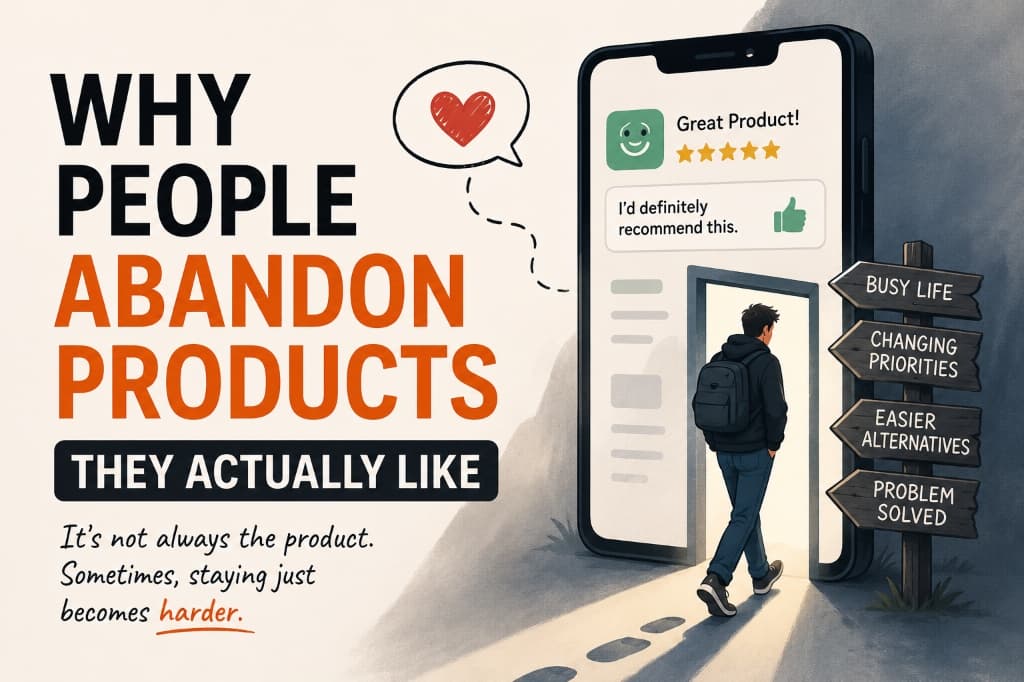
Why People Abandon Products They Actually Like
People can like your product and still stop using it. Discover why retention fails even for good products, and how friction, onboarding, feature fatigue, and habit shifts cause users to disappear.
Here's something every product team should find uncomfortable: People can like your product and still leave it.
They can enjoy using it.
They can recommend it to a friend.
They can even tell you, "I really like this product."
And then...
They stop using it.
No angry review.
No complaints.
No dramatic goodbye.
They just disappear.
That's what makes retention so difficult.
Because sometimes, the product isn't bad.
The user just stopped having a reason to come back.
Liking a Product Doesn't Mean You'll Keep Using It
Think about the apps on your phone that you genuinely like.
Maybe you enjoyed using them.
Maybe they solved a real problem.
Maybe you even paid for one.
But you're not using them anymore.
Why?
Because liking something doesn't automatically turn it into a habit.
People get busy.
Their priorities change.
Their problems change.
New tools appear.
And sometimes, another product simply becomes easier to use.
The product didn't necessarily get worse.
The user's life changed around it.
Friction Doesn't Always Feel Like Frustration
One of the easiest ways to lose users is to make the product slightly harder to use.
Not dramatically harder. Just slightly.
- Maybe they have to log in again.
- Maybe completing one task takes six clicks instead of two.
- Maybe an important feature is buried inside three menus.
- Maybe they have to configure the same thing every time.
None of these problems seem serious on their own.
But they add up.
Think about a door that takes an extra five seconds to open every time.
You probably wouldn't complain about it.
But after opening it hundreds of times, you'd start wondering: "Why is this so annoying?"
That's what friction does.
It doesn't always make users angry. Sometimes it just makes them tired.
And tired users eventually look for an easier option.
Your Onboarding Might Be Asking for Too Much
You can have an excellent product and still lose someone before they experience it.
- Create an account.
- Verify your email.
- Complete your profile.
- Choose your preferences.
- Connect an integration.
- Watch a tutorial.
- Invite your team.
- Configure your workspace.
And finally...
You get to the product.
By then, the user might already be thinking about leaving.
The problem isn't onboarding itself.
The problem is asking users to do too much before they've seen the value.
Whenever possible, let people experience the product first.
Then ask for the information you actually need.
Value should come before homework.
More Features Can Make a Product Harder to Love
Products grow. That's normal.
A new feature gets added. Then another. Then another setting. Then another workflow.
Eventually, the product becomes more powerful. But also more complicated.
The original users might adapt because they already understand the product.
New users don't have that advantage.
They see dozens of buttons, options, menus, and settings before they even know what matters.
This creates an interesting problem:
The product gets better on paper while becoming harder to use.
And sometimes users aren't leaving because your product lacks features.
They're leaving because it has too many.
Switching Is Expensive
There's another reason people stay with products they don't love: habits.
Imagine you've used the same note-taking app for three years.
Another app comes along. It's faster. It's cleaner. Maybe it's even better.
Are you going to switch immediately? Probably not.
Because switching means moving your data, learning a new interface, rebuilding workflows, updating integrations, changing habits, and convincing yourself that all of that effort is worth it.
That's switching cost.
It's one reason people stay with familiar products even when better alternatives exist.
But it also works the other way:
If your product makes switching into it extremely difficult, potential users may never make the move in the first place.
Your Competitor Doesn't Have to Be Better
They might just be easier.
- Fewer steps.
- Better defaults.
- Faster onboarding.
- Cleaner navigation.
- Better integrations.
- A more familiar workflow.
Users don't always compare products feature by feature.
They often ask a much simpler question: "Which one gets this done with less effort?"
That's why a product with fewer features can sometimes beat a much more powerful competitor.
Convenience is a feature too.
Your Best Feature Might Be Invisible
There's another problem that happens when products improve.
The team knows what's new. The users don't.
You launch a faster workflow. Users keep using the old one.
You redesign a feature. Users don't notice.
You add something that solves a major pain point. Most customers never find it.
From the team's perspective, the product has improved.
From the user's perspective... nothing changed.
That's why product improvements need communication.
Not every update needs a huge announcement. Sometimes a tiny message is enough:
"There's a faster way to do this now."
Good products don't just improve. They make sure users notice the improvement.
Value Can Slowly Become Invisible
When someone first signs up, their problem is usually fresh. They know exactly why they're there.
But months later, that problem might not feel as urgent.
The product hasn't changed. The user's situation has.
And suddenly, the product becomes easy to forget.
This is especially common with tools that solve occasional problems.
You might genuinely love a tool that you only need once every few months.
That's not necessarily bad retention. It might simply be the natural usage pattern of the product.
Which brings us to an important question:
Does your product actually need to be used every day?
Stop Trying to Make Everything a Daily Habit
There's a temptation to turn every product into a habit-forming machine.
Notifications. Streaks. Badges. Daily reminders. "Come back tomorrow!"
But not every product needs daily engagement.
If your tool solves a problem in ten minutes and users only need it once a month, that's perfectly fine.
The goal isn't: "How do we make users open this every day?"
The better question is: "When users have this problem again, are we the product they remember?"
That's a much healthier definition of retention.
Sometimes Users Leave Because You Did Your Job
This one is easy to overlook. Not every disappearing user is a churned customer.
Sometimes they simply finished what they came to do.
Imagine a tool that helps someone create App Store screenshots.
They sign up. Create their screenshots. Download them. Publish their app. And leave.
Did the product fail? Not necessarily.
The product did its job. The user had a problem. The product solved it. They moved on.
The challenge isn't always to invent a reason for them to return.
It's to find another genuine reason to return — without adding unnecessary features just to increase engagement.
Don't Build Before You Ask Why
When users disappear, the first instinct is often: "What should we build to bring them back?"
That's usually the wrong first question. Start with: "Why did they leave?"
Ask former users. You might hear:
- "I didn't need it anymore."
- "It became too complicated."
- "I found another tool."
- "I couldn't figure out how to do X."
- "I forgot about it."
- "It was too expensive."
Those are completely different problems. And they require completely different solutions.
If you don't understand the reason behind the churn, you might spend months fixing something that wasn't broken.
Retention Isn't Just a Product Problem
Retention sits at the intersection of several things:
- Product: Does it solve the problem?
- UX: Is it easy to use?
- Timing: Does the user still have the problem?
- Habits: Has using the product become natural?
- Communication: Do users know what's changed?
- Value: Do they still have a reason to return?
That's why retention is so difficult.
There isn't always one broken button you can fix.
Sometimes the product is working perfectly. The problem is somewhere around it.
You Don't Need to Keep Everyone Forever
Every product loses users.
Some users finish what they came to do. Some outgrow the product. Some switch to something else. Some simply stop having the problem you solve.
That's normal.
The goal isn't to keep every user forever. The goal is to understand why people leave.
Then separate the reasons you can control from the ones you can't.
If users leave because their problem disappeared, that's different from users leaving because your product became frustrating.
One is natural. The other is something you can fix.
Design store-ready screenshots in minutes — free, no export watermarks.
Launch Shots is free forever. Every template(110+), 220+ device frames plus 3D mockups, AI localization to 84 store languages, and direct upload to App Store Connect and Google Play Console. No credit card needed.
Start creating free →Final Thoughts
A user leaving doesn't automatically mean your product failed.
Maybe they found something better. Maybe their priorities changed. Maybe they finished what they came to do.
Or maybe...
They actually liked your product. But using it slowly became harder.
- One extra click.
- One confusing screen.
- One unnecessary setup step.
- One buried feature.
- One competitor that felt just a little easier.
None of these things feels big enough to cause churn. Until they do.
Because retention isn't always about giving users more reasons to stay.
Sometimes, it's about removing the reasons they have to leave.
People don't always abandon products because they're bad.
Sometimes they abandon products because staying became harder than leaving.